
Massive Adds x402 Payments Access for AI Agents with Coinbase
Massive US stock data is now available to AI agents via x402. Pay per request in USDC on agent.massive.com, with no account or API key. Built with Coinbase.

editor

Introducing
Jul 16, 2026
"We chose Massive mainly because of the quality and consistency of their data, especially on the options side. Our platform depends on accurately modeling volatility behavior and running simulations on current market conditions, so having clean, reliable options chains data in real-time was critical. "
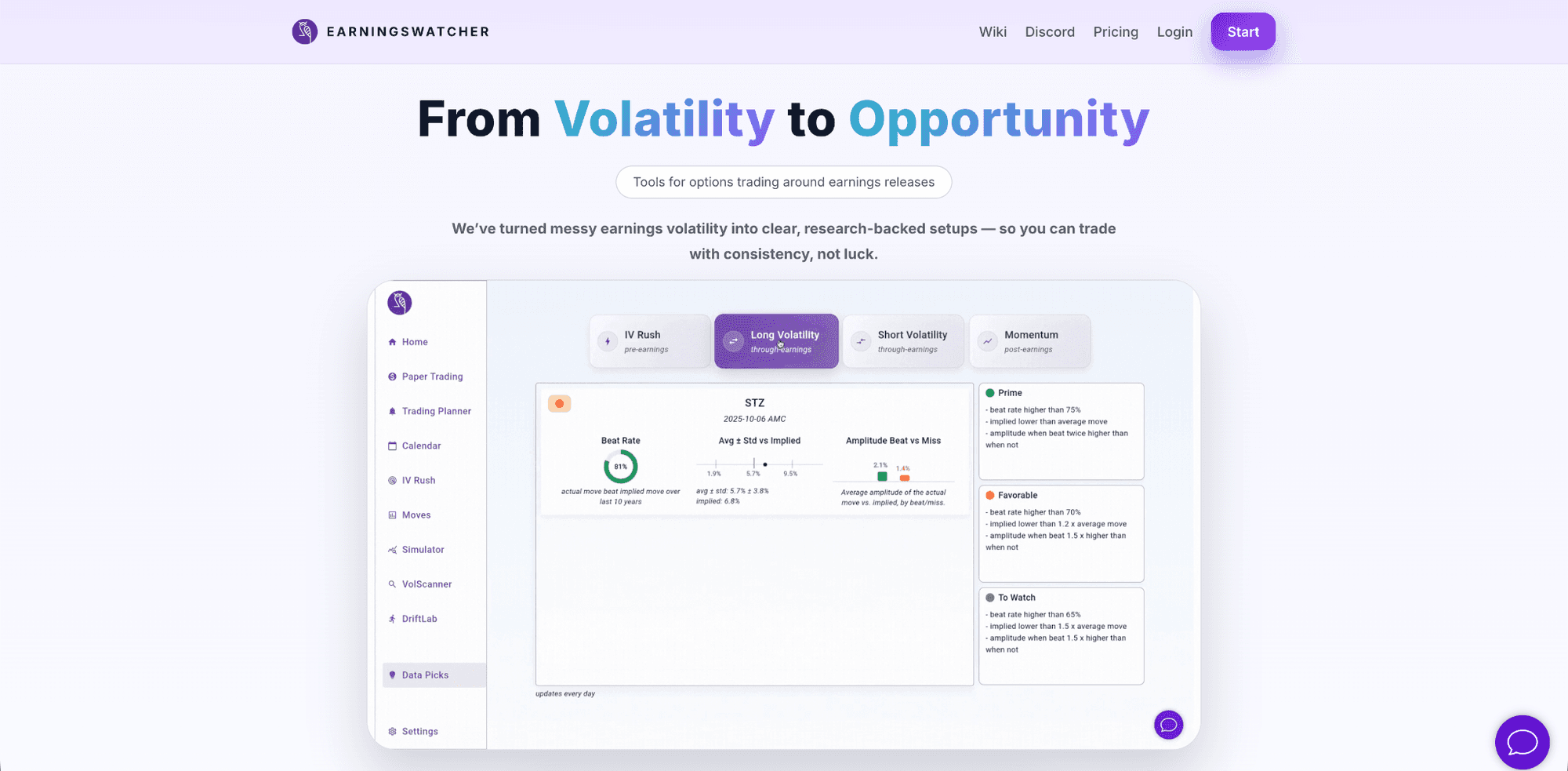
In this post, we'll walk through how Earnings Watcher built its analytics layer on Massive's options chains and snapshots, why Fair Market Value anchors its scanner, and how the same API pattern extended from options into post-earnings drift analysis on the underlying equity.
Earnings Watcher is a Paris-based platform built for a specific kind of trader: the retail options trader who wants to approach earnings systematically instead of treating them as coin flips. Founded by Amin Khribi, a former Palantir engineer trained at Ecole Centrale Paris, the team has grown a community of more than 1,000 traders who use the platform daily.
Their thesis is simple. Earnings are not random. The same patterns surface week after week in the way implied volatility ramps ahead of a release, in the gap between the priced move and the actual move, and in how certain names drift once the dust settles. Earnings Watcher built a set of tools that turn those patterns into structured, defined-risk setups, so traders can evaluate an earnings play the same way every time.
The platform does not sell signals. It does not predict earnings outcomes. It surfaces setups with probability stats, structures them with defined risk, and lets users test them against current options prices before any capital moves. That workflow depends on one thing above all else: the options data underneath has to behave the same way, every time, across every tool.
Earnings Watcher's core features are powered by two Massive endpoints: options contracts and snapshots. Options chains provide full contract details across every expiration for a given underlying. The snapshot endpoint delivers accurate, real-time pricing and implied volatility on those contracts, polled on demand.
Together, they give the team what they need to build their flagship feature, the earnings-focused options simulator. When a user wants to model a trade on a specific ticker, the simulator reads the current state of the chain, identifies relevant strikes and expirations, and runs a scenario that approximates IV crush using the term structure. Further-dated expirations anchor what the front-month implied volatility is likely to compress to once the event passes.
"Our screening and analytics are primarily powered by snapshot’s data. Massive's data has been especially valuable here. It gives us a reliable foundation to build our own analytics and modeling layer on top, turning raw options data into actionable insights for our users."
That processed data flows through to everything a user interacts with on the platform. VolScanner surfaces structured setups with break-evens, expected moves, and likelihood metrics. The simulator lets traders test different scenarios against current options prices. Moves Analyser and the backtester visualize the historical distribution of earnings reactions and detailed trade outcomes.
Options traders are unforgiving. A wide bid-ask spread, a stale print, or a crossed market in the wrong column gets spotted in seconds. For a screener that ranks dozens of contracts across strikes and expirations, noise in the inputs translates to misleading rankings and broken risk-reward outputs.
The same requirement carried into the simulator. By ensuring the data remained consistent from the scanner to trade modeling and execution, Earnings Watcher avoided the disconnects that can quickly undermine user trust when prices or risk profiles change unexpectedly between steps.
One specific piece of Massive's options coverage became central to Earnings Watcher's value proposition: Fair Market Value, an indicative value provided via snapshot and websocket to Options Business users.
When a screener has to compare dozens of contracts across strikes and expirations in seconds, noise is a real problem. Wide spreads, stale prints, and crossed markets can push a ranked list in misleading directions. Fair Market Value resolves to a single price point the team can trust for every contract.
"It gives us a single, reliable price point that reflects the true value of an option, without the noise you often get from broker quotes, wide spreads, or irregular trade prints. We've also cross-checked it against our own theoretical pricing models, and it's been very robust so far."
The downstream effect is cleaner rankings in the scanner, more consistent risk-reward calculations in the simulator, and fewer edge cases their users have to reason around before placing a trade.
Earnings Watcher's product surface is broad. VolScanner surfaces structured setups with break-evens, expected moves, and likelihood metrics. The simulator runs IV-crush scenarios using the term structure, anchoring front-month implied volatility against further-dated expirations once the event passes. IV Rush Radar projects whether pre-earnings implied volatility will outpace theta decay. Moves Analyser studies the distribution, dispersion, and outliers of historical earnings moves. DriftLab quantifies post-earnings drift and matches current runs against historical patterns. Each tool reads a different slice of market data, but every read follows the same consistent Massive API pattern:
"From a development standpoint, it allows us to build and iterate faster, since we don't have to handle multiple data structures or edge cases across different endpoints. But more importantly, users need to trust that the data behaves the same way across different tools, whether they're screening, simulating, or analyzing a trade."
That consistency matters for the engineering team, but it matters even more for the end user. When a trader uses VolScanner to filter candidates, moves into the simulator to model a structure, and then opens Moves Analyser to check the historical distribution, the prices and implied volatilities they see in each tool need to be derived from the same foundation. Consistency in the data layer translates directly into confidence in the analysis.
DriftLab shows how the same foundation extends into adjacent problems. While most of Earnings Watcher's tools work with options data, DriftLab works with the underlying equity. It reconstructs the full price path of a stock around an earnings report, before, during, and after, and turns that sequence into structured insights like drift tendencies, continuation probabilities, and gap-fill behavior.
That entire product is powered by Massive's stock aggregates endpoint.
"Because our platform is built around transforming raw data into analytics and then into user-facing tools, once we have that same quality of data for another asset class, we can apply the same approach without needing to rethink the whole system."
For Earnings Watcher, the measurable effect of a reliable data layer shows up in user engagement. Their core product hook is interactivity. Users simulate trades on current options data, explore volatility scenarios, and validate ideas before entering a position.
That only works if the numbers behind the simulation are trustworthy. Because the underlying data is stable, users can run scenarios, test strategies, and experiment with outcomes around earnings without fighting the foundation. The team points to that interactivity as the core of their retention.
Over a year into the partnership, Massive is embedded across Earnings Watcher's stack. Options chains and snapshots power the simulator, VolScanner, and IV Rush Radar. Fair Market Value cleans up the comparative analytics. Stock aggregates power DriftLab. The same consistent API pattern lets the team extend into new tools without rebuilding the foundation each time.
"During the integration phase, we had a lot of questions, did extensive testing, and needed to validate different assumptions, and their team was very responsive and patient throughout. We've now been with them for over a year without major issues. It's been a very solid and reliable partnership."
For a small team building for a demanding audience of options traders, that reliability is what frees engineering time to focus on research, modeling, and new tools instead of maintaining pipelines. Earnings Watcher did not set out to build a market data operation. They set out to make earnings volatility legible to retail traders, and they built that on infrastructure designed to grow with them. The ceiling is set by what the team can build, not by what the data layer can afford to serve.
If your team is building a fintech application, a trading platform, or a research tool that depends on accurate, real-time market data, reach out to sales@massive.com. We would be happy to learn about your project and help you build on the same foundation powering Earnings Watcher.
This content is for educational purposes only. Nothing in this post constitutes investment advice or a recommendation to buy or sell any securities or other financial instruments. Massive is a market data provider, not a broker-dealer, exchange, or investment adviser. Market data accessed through Massive may originate from third-party exchanges and data providers or may be derived or calculated by Massive; in either case, it is subject to the applicable terms of your Massive subscription agreement. The data and code samples provided by Massive are offered on an "as-is" basis without any warranty of accuracy, completeness, or timeliness. You are solely responsible for your use of the data provided by Massive and for compliance with all applicable terms and conditions, laws, and data licensing requirements.

Alex Novotny
alexnovotny
See what's happening at Massive
Massive US stock data is now available to AI agents via x402. Pay per request in USDC on agent.massive.com, with no account or API key. Built with Coinbase.
editor

Starting August 17, 2026, Cboe's Options Exchange is extending trading hours for select single-stock equity options with a morning GTH session (7:30–9:25 am ET) and Curb session (4:00–4:15 pm ET).

cole
A SEC 8-K API that labels what actually happened. Query filings by event type (CEO departures, cybersecurity incidents, M&A), with source-cited tags.

rian