Options Overview

At Massive, we offer a comprehensive suite of U.S. options market data through standardized and intuitive APIs. Our coverage includes real-time prices, historical data, and reference information sourced from all 17 U.S. options exchanges. Whether accessed via REST APIs, WebSocket streams, or flat files, this extensive dataset empowers both retail and professional users to develop advanced applications, execute informed trading strategies, and perform in-depth market analyses. By leveraging detailed trade data and consolidated quotes, our platform delivers robust analytical tools essential for comprehensive market insights and decision-making.

Available Endpoints

Browse the endpoints available for Options. Each row links to its dedicated documentation, with a short description and the API path.

Endpoints
Description
Contracts
All Contracts
Retrieve a comprehensive index of options contracts, encompassing both active and expired listings. This endpoint can return a broad selection of contracts or be narrowed down to those tied to a specific underlying ticker. Each contract entry includes details such as contract type (call/put), exercise style, expiration date, and strike price. By exploring this index, users can assess market availability, analyze contract characteristics, and refine their options trading or research strategies. Use Cases: Market availability analysis, strategy development, research and modeling, contract exploration.
GET/v3/reference/options/contracts
Contract Overview
Retrieve detailed information about a specific options contract, including its contract type (call or put), exercise style, expiration date, strike price, shares per contract, underlying ticker, and primary exchange. This endpoint provides essential attributes for understanding the contract’s structure and evaluating it within broader options strategies and portfolios. Use Cases: Contract specifications reference, option chain analysis, strategy development, portfolio integration.
GET/v3/reference/options/contracts/{options_ticker}
Aggregate Bars (OHLC)
Custom Bars
Retrieve aggregated historical OHLC (Open, High, Low, Close) and volume data for a specified options contract over a custom date range and time interval in Eastern Time (ET). Aggregates are derived exclusively from qualifying trades that meet specific conditions. If no eligible trades occur within a given timeframe, no aggregate bar is produced, resulting in an empty interval that indicates a lack of trading activity during that period. Users can tailor their data by adjusting the multiplier and timespan parameters (e.g., a 5-minute bar). This flexibility supports a broad range of analytical and visualization needs for options markets. Use Cases: Data visualization, technical analysis, backtesting strategies, market research.
GET/v2/aggs/ticker/{optionsTicker}/range/{multiplier}/{timespan}/{from}/{to}
Daily Ticker Summary
Retrieve the opening and closing prices for a specific options contract on a given date, along with any pre-market and after-hours trade prices. This endpoint provides essential daily pricing details, enabling users to evaluate performance, conduct historical analysis, and gain insights into trading activity outside regular market sessions. Use Cases: Daily performance analysis, historical data collection, after-hours insights, portfolio tracking.
GET/v1/open-close/{optionsTicker}/{date}
Previous Day Bar
Retrieve the previous trading day's open, high, low, and close (OHLC) data for a specified option contract. This endpoint provides key pricing metrics, including volume, to help users assess recent performance and inform trading strategies. Use Cases: Baseline comparison, technical analysis, market research, and daily reporting.
GET/v2/aggs/ticker/{optionsTicker}/prev
Snapshots
Option Contract Snapshot
Retrieve a comprehensive snapshot of a specified options contract, consolidating vital metrics and market data into a single response. This endpoint provides details such as break-even price, day-over-day changes, implied volatility, open interest, greeks (delta, gamma, theta, vega), and the latest quote and trade information. Users also gain insights into the underlying asset’s current price, enabling a full evaluation of the contract’s value and potential. Use Cases: Trade evaluation, market analysis, risk assessment, and strategy refinement.
GET/v3/snapshot/options/{underlyingAsset}/{optionContract}
Option Chain Snapshot
Retrieve a comprehensive snapshot of all options contracts associated with a specified underlying ticker. This endpoint consolidates key metrics for each contract, including pricing details, greeks (delta, gamma, theta, vega), implied volatility, quotes, trades, and open interest. Users also gain insights into the underlying asset’s current price and break-even calculations. By examining the full options chain in a single request, traders and analysts can evaluate market conditions, compare contract attributes, and refine their strategies. Use Cases: Market overview, strategy comparison, research and modeling, portfolio refinement.
GET/v3/snapshot/options/{underlyingAsset}
Unified Snapshot
Retrieve unified snapshots of market data for multiple asset classes including stocks, options, forex, and cryptocurrencies in a single request. This endpoint consolidates key metrics such as last trade, last quote, open, high, low, close, and volume for a comprehensive view of current market conditions. By aggregating data from various sources into one response, users can efficiently monitor, compare, and act on information spanning multiple markets and asset types. Use Cases: Cross-market analysis, diversified portfolio monitoring, global market insights, multi-asset trading strategies.
GET/v3/snapshot
Trades & Quotes
Trades
Retrieve comprehensive, tick-level trade data for a specified options ticker within a defined time range. Each record includes price, size, exchange, trade conditions, and precise timestamp information. This granular data is foundational for constructing aggregated bars and performing in-depth analyses, as it captures every eligible trade that contributes to calculations of open, high, low, and close (OHLC) values. By leveraging these trades, users can refine their understanding of intraday price movements, test and optimize algorithmic strategies, and ensure compliance by maintaining an auditable record of market activity. Use Cases: Intraday analysis, algorithmic trading, market microstructure research, data integrity and compliance.
GET/v3/trades/{optionsTicker}
Last Trade
Retrieve the latest available trade for a specified options contact, including details such as price, size, exchange, and timestamp. This endpoint supports monitoring recent trading activity and updating dashboards or applications with the most current trade information, providing timely insights into ongoing market conditions. Use Cases: Trade monitoring, price updates, market snapshot.
GET/v2/last/trade/{optionsTicker}
Quotes
Retrieve historical quotes for a specified options contract over a defined time range. Each record provides bid and ask prices, sizes, exchange identifiers, and precise timestamps, reflecting the options market conditions at each captured moment. By examining this data, users can analyze price movements, evaluate market interest in specific strikes and expirations, and refine their options trading or research strategies. Use Cases: Historical quote analysis, market interest evaluation, algorithmic backtesting, strategy refinement.
GET/v3/quotes/{optionsTicker}
Technical Indicators
SMA
Retrieve the Simple Moving Average (SMA) for a specified ticker over a defined time range. The SMA calculates the average price across a set number of periods, smoothing price fluctuations to reveal underlying trends and potential signals. Use Cases: Trend analysis, trading signal generation (e.g., SMA crossovers), identifying support/resistance, and refining entry/exit timing.
GET/v1/indicators/sma/{optionsTicker}
EMA
Retrieve the Exponential Moving Average (EMA) for a specified ticker over a defined time range. The EMA places greater weight on recent prices, enabling quicker trend detection and more responsive signals. Use Cases: Trend identification, EMA crossover signals, dynamic support/resistance levels, and adjusting strategies based on recent market volatility.
GET/v1/indicators/ema/{optionsTicker}
MACD
Retrieve the Moving Average Convergence/Divergence (MACD) for a specified ticker over a defined time range. MACD is a momentum indicator derived from two moving averages, helping to identify trend strength, direction, and potential trading signals. Use Cases: Momentum analysis, signal generation (crossover events), spotting overbought/oversold conditions, and confirming trend directions.
GET/v1/indicators/macd/{optionsTicker}
RSI
Retrieve the Relative Strength Index (RSI) for a specified ticker over a defined time range. The RSI measures the speed and magnitude of price changes, oscillating between 0 and 100 to help identify overbought or oversold conditions. Use Cases: Overbought/oversold detection, divergence analysis, trend confirmation, and refining market entry/exit strategies.
GET/v1/indicators/rsi/{optionsTicker}
Market Operations
Exchanges
Retrieve a list of known exchanges, including their identifiers, names, market types, and other relevant attributes. This information helps map exchange codes, understand market coverage, and integrate exchange details into applications. Use Cases: Data mapping, market coverage analysis, application development (e.g., display exchange options), and ensuring regulatory compliance.
GET/v3/reference/exchanges
Market Holidays
Retrieve upcoming market holidays and their corresponding open/close times. This endpoint is forward-looking only, listing future holidays that affect market hours. Use this data to plan ahead for trading activities and system operations. Use Cases: Trading schedule adjustments, integrated holiday calendars, operational planning (e.g., system maintenance), and notifying users about upcoming market closures.
GET/v1/marketstatus/upcoming
Market Status
Retrieve the current trading status for various exchanges and overall financial markets. This endpoint provides real-time indicators of whether markets are open, closed, or operating in pre-market/after-hours sessions, along with timing details for the current or upcoming trading periods. Use Cases: Real-time monitoring, algorithm scheduling, UI updates, and operational planning.
GET/v1/marketstatus/now
Condition Codes
Retrieve a unified and comprehensive list of trade and quote conditions from various upstream market data providers (e.g., CTA, UTP, OPRA, FINRA). Each condition identifies special circumstances associated with market data, such as trades occurring outside regular sessions or at averaged prices, and outlines how these conditions affect metrics like high, low, open, close, and volume. By examining these mapped conditions, users can accurately interpret the context of trades and quotes, apply appropriate filtering, and ensure that aggregated data correctly reflects eligible trading activity. Use Cases: Data interpretation, unified condition mapping, filtering and analysis, algorithmic adjustments, compliance and reporting.
GET/v3/reference/conditions

Market Hours and Timezone

Data for U.S. options primarily aligns with regular market hours:

  • Regular Market Hours: Monday through Friday, 9:30 AM to 4:00 PM Eastern Time (ET)

While some exchanges may offer limited trading outside of these hours, options activity predominantly occurs during regular sessions. All timestamps in the datasets are provided as Unix timestamps (seconds since epoch, UTC). When converting these timestamps into human-readable form (e.g., market open at 9:30 AM), remember they represent UTC time, not Eastern Time (ET). To correctly align data with market hours or dates, you'll need to explicitly convert timestamps from UTC to ET during your analysis.

Infrastructure and Reliability

Our robust infrastructure begins at the core of the U.S. options market: the Options Price Reporting Authority (OPRA). By co-locating with OPRA and maintaining direct connections to all U.S. options exchanges, we minimize latency and maximize data integrity. Each trading day, we process and store approximately 3 terabytes of options data, supported by advanced, scalable data handling systems designed for the market's high throughput and complexity. This reliable infrastructure ensures timely and accurate market information, maintaining the highest standards of speed, resilience, and compliance.

Data Flow: From Exchanges to You

Our options data originates from all 17 U.S. options exchanges, capturing every quote and trade across the market. Exchanges provide their data to OPRA, which consolidates it into a single feed containing the official National Best Bid and Offer (NBBO) and trade information.
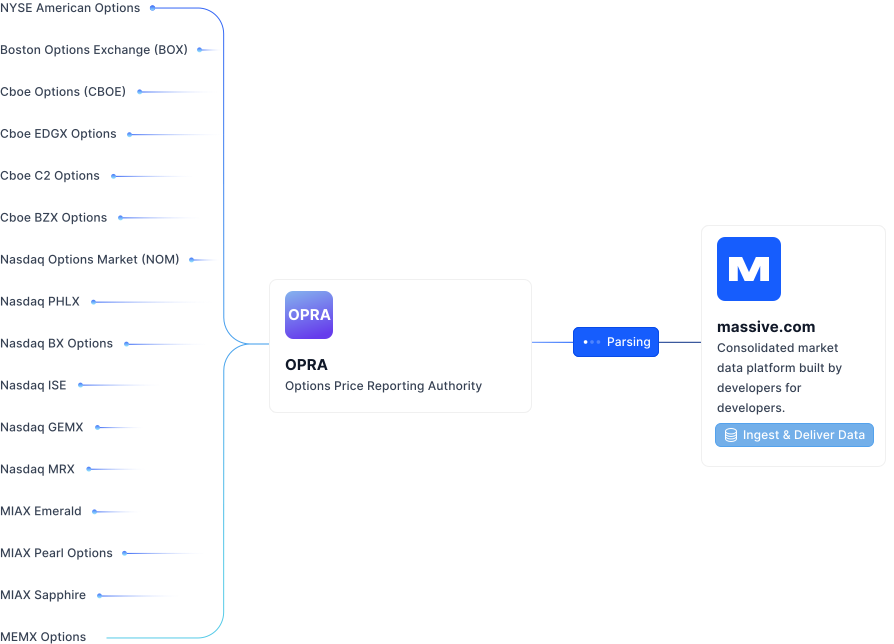
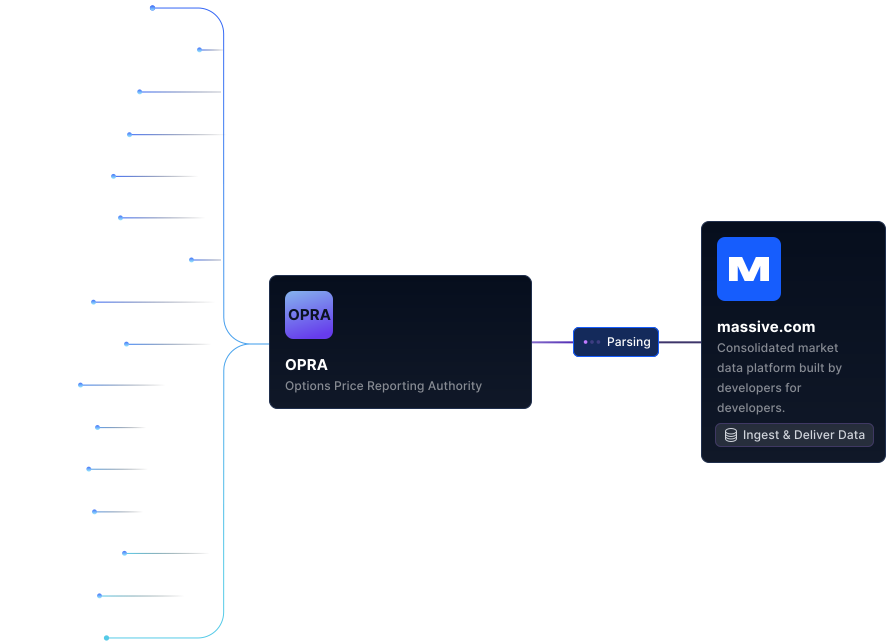
The flow of U.S. options market data from major exchanges (e.g., NYSE, Nasdaq, Cboe) through OPRA and direct connections to Massive's co-located data facilities.

By connecting directly to OPRA, we deliver a unified and comprehensive view of the entire U.S. options landscape, covering equities, ETFs, indices, and currencies, with futures options coming soon.

The U.S. options market includes:

  • NYSE American Options
  • Boston Options Exchange (BOX)
  • Chicago Board Options Exchange (CBOE)
  • Cboe EDGX Options
  • Cboe C2 Options
  • Cboe BZX Options
  • Nasdaq Options Market (NOM)
  • Nasdaq PHLX
  • Nasdaq BX Options
  • Nasdaq ISE
  • Nasdaq GEMX
  • Nasdaq MRX
  • MIAX Emerald
  • MIAX Pearl Options
  • MIAX Sapphire
  • MEMX Options

By aggregating data from these exchanges, OPRA ensures that all market participants have equal access to consolidated market data. Our direct connection to OPRA allows us to deliver timely, accurate data that supports market transparency and informed decision-making.

What are Securities Information Processors (SIPs)?

In the options market, OPRA functions similarly to Securities Information Processors (SIPs) in the equities markets. OPRA consolidates trade and quote data from all participating options exchanges and distributes this standardized information to market participants. This process ensures equal access to official NBBO and last sale data, upholding market transparency and fairness.

Our integration with OPRA ensures that you receive comprehensive and timely options market data, enabling effective strategies, analyses, and application development.

Regulatory Compliance

We adhere to all regulatory requirements governing the distribution of U.S. options market data. Through strict compliance with exchange licensing agreements and OPRA policies, we ensure that both non-professional and professional users can access data within the appropriate guidelines. For business clients, we offer tailored plans that accommodate various licensing requirements, providing the flexibility needed to serve a wide range of professional trading environments while maintaining data integrity and legality.

Next Steps

Explore our REST APIs and WebSocket streams to unlock the full potential of our U.S. options data. Our documentation guides you through integrating real-time and historical market information, enabling tasks such as:

  • Monitoring real-time trades and quotes
  • Accessing historical tick-level data for research
  • Constructing custom aggregate bars for technical analysis
  • Analyzing implied volatility, greeks, and open interest
  • Integrating options data with underlying asset information

By leveraging our comprehensive options dataset, you can build sophisticated trading algorithms, perform detailed market analyses, and develop applications that require timely and accurate options market data.

Did you find this page helpful?
Do you still need help with something?