Hardly anyone gets this one right on first read, and that is not your fault. The test was written by the exchanges for their own fee schedules rather than for the person filling it in, and one of its questions runs backwards. The short version below sorts most people out in about a minute, and the eleven-line checklist after it handles everyone else. Because the test belongs to the exchanges rather than to Massive, it follows you to every other market data vendor too, which is also why our plans split into Individual and Business rather than into small and large.
Applies to
- Plans: Individual plans are for non-professional subscribers only. Professional subscribers use the Business plans on massive.com/business.
- Endpoints: all of them. Nothing in the API behaves differently, because this is a licensing question rather than a technical one.
- Asset classes: all. Massive asks everyone the same eleven questions whichever you buy, but the definitions sitting behind them are written exchange by exchange, and the index providers do not price on whether an individual is professional or non-professional.
The short version
The short version, for anyone who only wants to know which plans they can buy: you are professional if any one of these is true.
- A regulator has you registered or qualified: the SEC, the CFTC, a state securities agency, an exchange or an association. Or you do work that would need that registration if you did it somewhere else.
- You are engaged to advise on investments or to manage money, paid or not.
- The data is for a business, an employer or any other entity. That includes receiving it through a company's account instead of your own name even when what you do with it is personal, and it includes the LLC a lot of people set up to trade their own money.
- You trade with someone else's capital, you share the profits of your trading, or you are paid for it. Trading your own account on margin is fine and does not count.
- You get office space, equipment or other benefits in exchange for trading or for financial consulting.
None of those true, and the account is in your own name? You are non-professional, and the Individual plans are yours.
| If you are | What you buy |
|---|---|
| Non-professional | Individual plans, self-serve at massive.com/pricing |
| Professional | Business plans at massive.com/business |
Two things are not on that list, though people brace for them every time: how much data you pull, and where in the world you live. Volume is a plan question rather than a status one, and someone outside the US is judged on whether they do the same work a registered person would do here.
If none of that settled it, the rest of this page is the exact test.
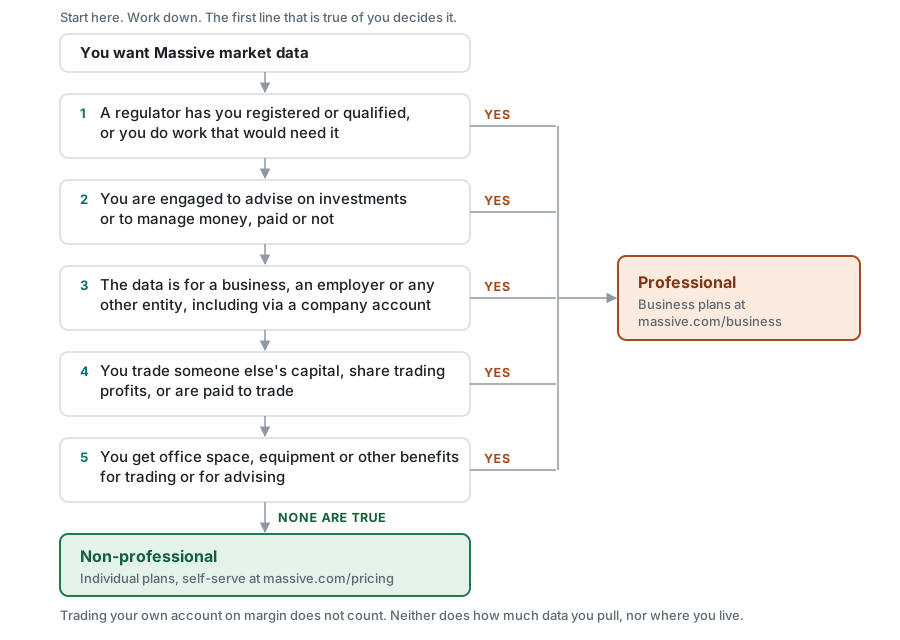
The same five checks are written out above the chart, so nothing here depends on being able to see it.
The eleven checks, all pointing the same way
The eleven checks below are the registration test rewritten as statements, so every one of them points in the same direction. If any single line is true of you, you are professional. If none of them is, you are non-professional. No counting, no partial credit.
They are numbered in the form's order, but line 1 here is deliberately the reverse of the form's question 1, which is the one question on the form where yes is the non-professional answer:
| # | True of you? |
|---|---|
| 1 | Your use of the data is anything other than purely personal and non-business |
| 2 | You receive the data for a business or any other entity |
| 3 | You are registered or qualified with the SEC or the CFTC |
| 4 | You are registered or qualified with any securities agency, exchange, association or regulatory body, or any commodities or futures contract market, in the US or elsewhere |
| 5 | You perform functions similar to those that require such registration, wherever you are based |
| 6 | You are engaged to provide investment advice to any individual or entity |
| 7 | You are engaged as an asset manager |
| 8 | You trade using the capital of another individual or entity. Trading your own account on margin does not count |
| 9 | You conduct trading for the benefit of a corporation, partnership or other entity |
| 10 | You have agreed to share the profit of your trading, or to be paid for it |
| 11 | You receive office space, equipment or other benefits in exchange for your trading or your work as a financial consultant |
There is no partial credit and no size threshold, which is why line 9 on its own puts a two-person shop in the same category as a bank.
Why this reads differently from the form you signed
The registration form asks these as eleven questions rather than eleven statements, and its first question runs the opposite way: "Do you use market data solely for your personal, non-business use?", where yes is the non-professional answer while yes to every other question is the professional one. That single reversal is what makes the form so hard to hold in your head, and it is not ours: the same eleven, in the same order, with the same flip on question one, are what other market data vendors ask, because they all trace back to the same exchange definitions.
The statements above are that same test with the reversal taken out. Nothing is added or removed. If you are filling in the actual form, the exact wording is in Understanding Professional Status and it governs.
One more thing the form does not say out loud: professional is the default. The exchanges require the vendor to establish that you qualify before giving you a non-professional rate, so an unanswered or unclear questionnaire leaves you professional rather than pending. NYSE's policy puts it as a precondition: a subscriber may not receive data as a nonprofessional unless the vendor first determines that they fall within the definition.
What the definitions actually say
What the definitions actually say is narrower than most summaries of them. The two that matter most are the pair the US stock and options plans share.
A non-professional subscriber is a natural person who receives market data solely for personal, non-business use and is not otherwise a professional subscriber. Under the US stock and options definitions, an entity such as a company, LLC, joint venture or partnership cannot be non-professional no matter what it does with the data. Trusts are a narrow exception under some of those policies, and CME writes the entity half of the test differently again for futures; both are in the table below. Massive is stricter than either of those exceptions: we register an account to a natural person, so no entity and no trust is registered as a non-professional subscriber here, for any asset class.
A professional subscriber is an individual who is registered or qualified with the SEC, the CFTC, a state securities agency, an exchange or association, or a self-regulatory body; or is engaged as an investment adviser as defined in Section 202(a)(11) of the Investment Advisers Act of 1940, registered or not; or is employed by a bank or other exempt organisation to perform functions that would otherwise require registration. Someone working outside the US who performs the same functions is treated the same way.
Note what is in neither definition: how much data you pull, how often you call the API, what you are willing to pay, or where you live. Volume is a plan question. This is not.
Each exchange writes its own version
The eleven questions above are how Massive asks, and they are drawn to satisfy every exchange at once. The underlying definitions are not identical, so if you are anywhere near the line it is worth reading the one that governs the data you actually want. Here is who writes what:
| Whose data | Where the definition lives | What is distinctive about it |
|---|---|---|
| Nasdaq-listed stocks, through the UTP plan | Section 16 of the UTP subscriber agreement | Defines a non-professional purely as a natural person who is not registered, not an investment adviser and not employed by an exempt bank. The personal-use requirement sits in the licence clause rather than in the definition |
| NYSE-listed stocks, through the CTA plan | The CTA Nonprofessional Subscriber Policy | Same three-part test, but personal, non-business use is part of the definition itself. Its clarifications spell out that receiving data through an organisation's account makes you professional even if your use is personal |
| NYSE proprietary products | NYSE Nonprofessional Subscriber Policy | The same definition and most of the same clarifications as CTA, including that a trust itself can never be non-professional while an unpaid trustee who otherwise qualifies can be. Where it is stricter: a qualifying trust may have only one trustee, against CTA's four, and an investment club member who receives professional assistance may not qualify |
| US options, through OPRA | OPRA's policy on the term, which points to the Addendum for Nonprofessionals in its subscriber agreements | The most permissive of the four equity and options definitions. Since 27 August 2008 it admits certain qualifying trusts, and allows a person to qualify while using the data for the benefit of certain immediate family members |
| Futures and options on futures. CME is also the source of the Dow Jones index family Massive carries | CME Group's Schedule 5 to the Information License Agreement: the definition on page 3, the conditions in section 8 | The one place an entity can qualify, and a futures test rather than an index one. CME defines a non-professional as a natural person or certain small business entities, LLCs among them, provided the subscriber has an active futures trading account, is not an exchange member, is not registered or qualified as a professional trader or investment adviser, is not acting for a financial institution, uses at most two order-routing devices, and uses the data only for personal or private purposes and only to manage its own assets. That first condition is what keeps this a futures category: CME's published fee lists carry non-professional rates for its futures information, not for the Dow Jones index data |
| Nasdaq indices, through the Global Index Data Service | Nasdaq's Index Data Usage and Distribution Policy, version 2.0 | Does not define professional or non-professional and does not price on them. Its one mention of the terms says an enterprise licence may apply to either. It counts devices and unshared logins, and prices on how the data is used and shared rather than on who you are: inside or outside your organisation, on a screen or machine-to-machine, real time or end of day, raw or derived |
| Cboe indices | Cboe Global Indices, under the index data fee schedule to its customer agreement | Also has no status test for individuals. Cboe's fee schedule, dated January 2018, uses the words only to sort the regulated firms that pass data to their own brokerage and advisory clients, classifying one as Retail or Institutional by whether more than 65% of its client accounts are held by non-professionals |
Three things follow from that table. A person can be non-professional for one exchange's data and professional for another's, which sounds odd but is genuinely how it works. Being registered with a regulator, engaged to advise, or trading someone else's capital puts you on the professional side of every definition that draws the line at all. And for index data the question largely stops being about you and becomes a question about how the data is used and shared, which is why index access is priced the way it is.
Which index provider stands behind a given index is in the source_feed field on the ticker. As of September 2026, of the 13,335 indices Massive carries, 10,006 come from Nasdaq's Global Index Data Service, 2,245 from Cboe Global Indices, and 1,084 from CME's Dow Jones feed. That field names the feed the index arrives on rather than the index's owner, so for the Morningstar, FTSE and MSCI families carried on Cboe's feed, the provider's own terms may apply on top.
If you trade through an LLC
If you trade through an LLC, a single-member LLC included, the answer for US stocks and options is that you are a professional subscriber, and this catches people out often enough to deserve its own heading. The reasoning is short: those definitions are written around a natural person, and an LLC is not one, however sure you are that the money and the trading are entirely your own.
This is not us reading the rules strictly. Massive asked for it to change. In a comment letter on the new consolidated tape, we asked for a targeted exception for single-member LLCs and other disregarded entities where the beneficial owner is a natural person using the data solely for personal purposes. The plan's operating committee declined, saying an exception would undo the simplification they were after, would force auditors to look much harder at every such entity, and could make a safe harbour unworkable. In its order of 26 June 2026 the SEC found that response reasonable and approved the schedule. As the order describes it, the first half of the new definition makes professional "any use of market data by or on behalf of any entity (for example, a corporation, company, partnership, limited partnership, limited liability company or association), except trusts not for compensation"; the second half covers an individual using the data to serve someone else for payment.
Two caveats worth having. As of September 2026 that approved fee schedule is not yet in force: it takes effect when the new consolidated tape becomes fully operational, no start date has been announced, and the plan's own outer deadline for it is May 2027. Until then the definitions in the table above are the ones that govern. And CME's futures definition is the one that does admit small business entities, on the conditions listed above. That is CME's rule rather than ours: a Massive account is registered to a natural person, so whichever asset class you are buying, an LLC needs a Business plan here. If your situation is futures and that distinction matters to you, send us a message and we will walk through it with you.
The cases that come up most
The cases that come up most are below, drawn from the exchange policies above and from our own registration guidance. They do not all land where people expect:
| Your situation | Classification |
|---|---|
| Retired or inactive professional, listed as Not Registered with FINRA | May qualify as non-professional. You must tell us and re-verify |
| Trading your own account full time, nobody else's capital | Non-professional, as long as none of the eleven checks above is true of you |
| Using your employer's account or email for personal trading | Professional. The account has to be in your own name |
| Trading your own money through an LLC you own | Professional. An LLC is not a natural person, so the stock and options definitions exclude it. CME's futures definition is the exception, but the Massive account still has to be in your own name |
| An investment club as an entity | Professional. The account has to be a natural person's, and the stock and options policies exclude a club |
| An individual member of an investment club, unpaid | Non-professional, if they qualify on their own |
| Trustee or beneficiary, unpaid | Non-professional, if they otherwise qualify |
| Showing prices to clients, or inside a product other people pay for | Professional. This one is our reading of the definitions rather than a line in the source |
What to do with your answer
What to do with your answer depends on which side you landed:
- If you are non-professional, the Individual plans are yours and there is nothing else to do.
- If you are professional, you need a Business plan. Do not assume it is the Individual plan at a higher price: the Business plans are packaged differently, and some data an Individual Advanced tier includes is sold as a separate expansion on the Business side.
- If you are near the line, or two answers seem to pull against each other, describe what you are actually doing in a chat at massive.com/contact. That conversation takes minutes, we would far rather have it before you buy, and it is the entire reason we offer it.
- If you know you are professional and want help choosing a plan, go to sales through massive.com/business or sales@massive.com.
- If your circumstances change, tell us. Taking a job that registers you, or that has you doing work which would need registration, changes your status the day you start, and so does moving the account into an employer's name.
The full wording of our registration questions, which governs if it differs from the summary above, is in Understanding Professional Status. Where an exchange's own definition differs, that exchange's policy governs its data.
Why the exchanges care
The exchanges care because their fee schedules charge per user and per category, and they hold the vendor responsible for classifying people correctly. That is why you are asked at signup rather than left to work it out later, and why the price gap is a licensing cost rather than any difference in the data itself. Getting it right protects you as much as it protects us: a misclassification found in an audit can mean back charges or an interruption to your access, and an accurate answer on day one is what keeps the data flowing.
If you see an error
Nothing in the API refuses a request because of your classification, so a refusal you see is about your subscription rather than your status.
{"status":"NOT_AUTHORIZED"} means the product or tier does not cover the request. It is not a professional-status check.
An account created in a company name cannot be corrected to non-professional by changing how you use the data, because the account has to be in a natural person's own name. If that is the only thing standing between you and an Individual plan, message us at massive.com/contact before you buy anything else and we will tell you what moving to a personal account involves.